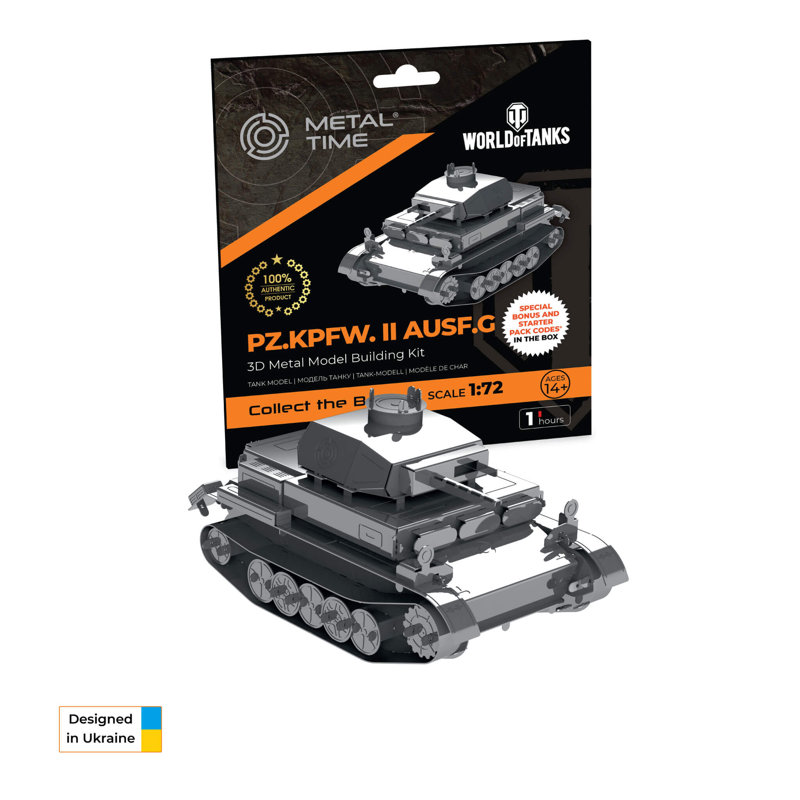
On June 18, 1938, MAN and Daimler-Benz received an order for an initial batch of 75 Pz II Ausf. G tanks. A prototype was manufactured in 1939. The vehicle was produced from April 1941 through February 1942, with a total of only 12 tanks built.
World War II brought armored vehicles to the forefront, making them the main striking force. But it all began not with heavy, unstoppable, powerful machines with siege weapons, but with small maneuverable tanks. One of the remarkable examples of engineering creativity of the 1940s is the German "Panzer II Ausf G". A chain of modifications to the basic model, which was one of the most numerous tanks until 1942, led to its appearance.
The "Panzer II Ausf G" significantly increased in speed. Unlike its rather slow predecessor, it could reach speeds of up to 50 km/h on the highway, which improves its mobility. Due to its good maneuverability, this light tank could perform tasks of escorting and providing fire cover for infantry even better.
Its armor was sufficient to protect against small arms and mines, but artillery strikes became fatal for the Panzer II. The main weapon of the "Panzer II Ausf G" remained the 20mm automatic cannon and the 7.92mm MG-34 machine gun. The main protection was the turret design with ricochet angles, which allowed to soften or deflect enemy shell hits.
The “Panzer II Ausf G” crew consisted of three people. Unlike the previous model, the driver and radio operator received viewports in the front and sides of the hull, improving the combat vehicle's maneuverability.