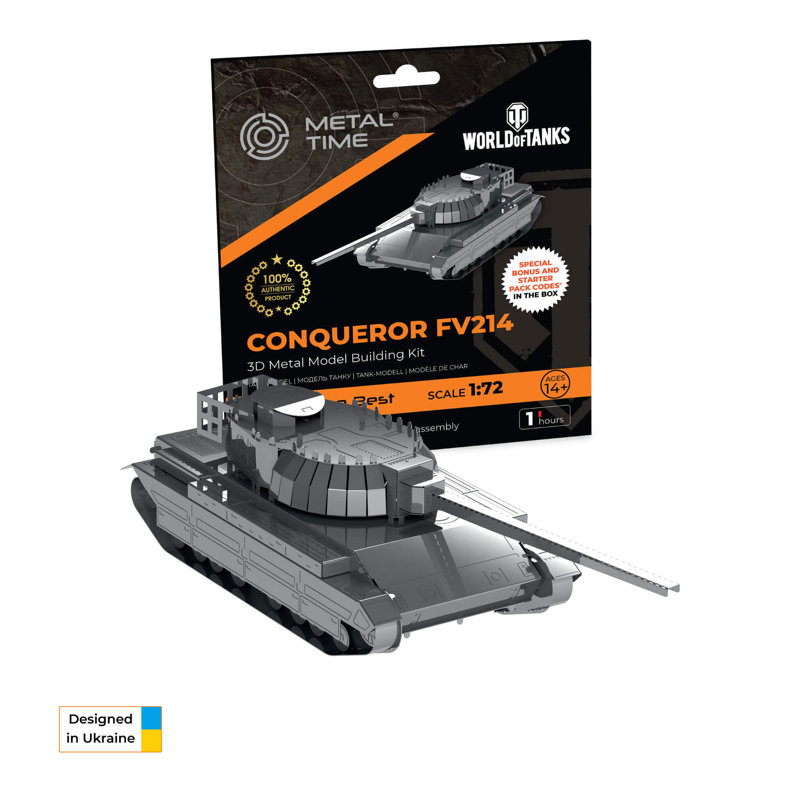
The FV214 Conqueror was conceived in 1946 as a response to two other categories of vehicles: the German panzer tanks that had demonstrated superior firepower during World War II, and the Soviet IS-3 heavy tank that entered service in 1945. The Conqueror’s 120mm gun was considered an advantage, but tank crews generally found the vehicle difficult to maneuver. Once the Centurion was outfitted with a 105mm gun, the Conqueror was withdrawn from use in the 1960s.
Large-scale battles did not accompany the Cold War on the battlefield. But fierce battles raged in the design bureaus. New military challenges demanded new technical solutions. British engineers, abandoning the idea of "cruiser" tanks, began to develop heavy ones. One of the promising models was the FV 214 "Conqueror". The project of the over 60 tons tank appeared in 1949, but this tank went into serial production only in 1955.
The main weapon of the tank was a 120-mm gun. The length of the fighting vehicle together with the cannon was more than 11 meters. The engine with a power of 810 hp drove this huge thing with a speed of up to 35 km/h on a hard surface. The aiming fire could be made only from a standing position.
In combat, the main firepower of the "Conqueror" was two 7.63 mm M1919 machine guns.
Distinctive features of the tank's architecture were a turret and hull with ricochet panels and a chassis with four bogies of two rollers and two drive wheels.
The crew of the heavy tank consisted of four men. The mechanic driver was in the platform and three other soldiers were in the turret. There was also a commander's turret with all-round visibility.
In addition to combat duty in the British Armed Forces, the "Conqueror" was a testing ground for engineering research. Its weak point was considered insufficient protection, but this was corrected in the new modifications. However, the tank could not withstand competition with other models and its production was stopped by the 60s.