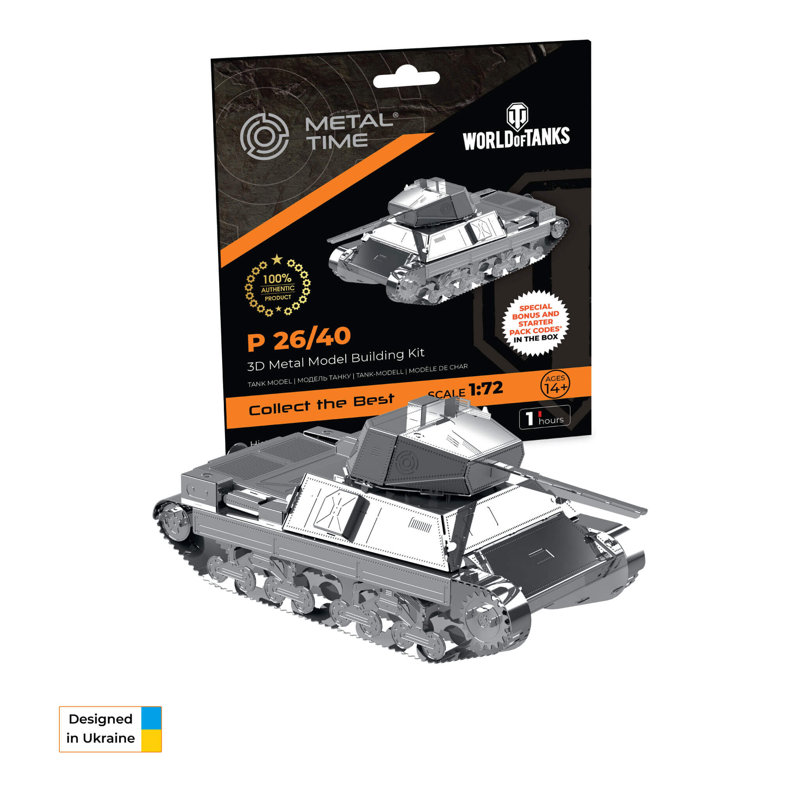
Development of this vehicle started at the end of 1940, but due to difficulties in finding a suitable engine, the first prototype was manufactured only at the beginning of 1942. Mass production was launched in 1943 in Turin. After Italy’s capitulation in the autumn of 1943, the tank entered service under the designation Panzerkampfwagen P40 737(i) and was used by the German reserve divisions as permanent fire positions. A total of 100 vehicles were produced.
In the history of World War II, there are tanks that were "unlucky". Some of them were ahead of their time, some were hopelessly behind the times. One of these combat vehicles was the Italian heavy tank "P 26/40". Promising development stalled for years due to technological problems, and as a result, this tank did not become massive and did not have an impact on the battlefields.
The "P 26/40" was one of the last riveted hull tanks in its class. In this, it differed from the similar geometry and basic parameters of the Soviet T-34 with its cast and welded parts and assemblies. The second feature was a semi-elliptical spring suspension with rollers assembled in carts. It seemed conditionally vulnerable, unlike more modern form factors. The third problem that was never solved was the engine.
Nevertheless, the "P 26/40" was a powerful offensive combat vehicle, which had good armament and driving performance. With a weight of 26 tons, its speed was to 40 km/h on paved roads, and it could autonomously overcome to 280 km. Armor with a thickness of 40-60 mm provided protection against bullets, fragments, mines, and tangential impacts of shells.
The main gun of the "P 26/40" was a 75 mm Ansaldo L/34 cannon and two 8 mm Breda machine guns.
The crew of "P 26/40" consisted of three people. The commander was in the turret, and served as a gunner.