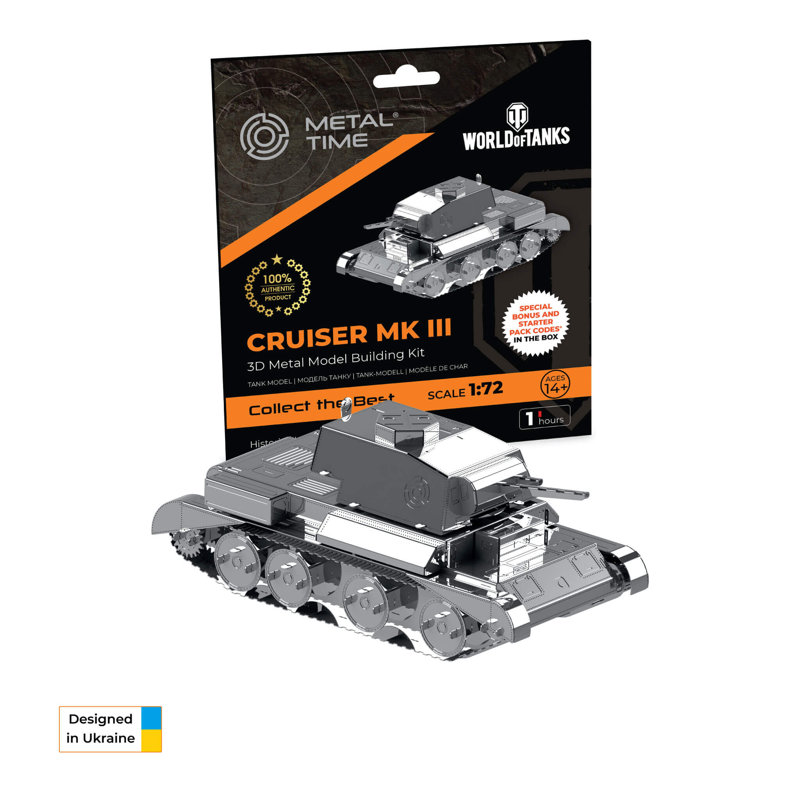
Developed by extensively upgrading two prototype M1931 Christie tanks purchased by the British Army in 1936. The vehicle was designed to be a fast, lightly-armored breakthrough tank. The modified design was deemed successful and became the basis for other cruiser tanks. Sixty-five vehicles of this type were built and saw combat in France and North Africa in 1940 and 1941.
The British army began to prepare for the inevitable war at the beginning of the 30s. The industry was moving to a military footing, engineers were looking for advanced solutions for military equipment. American designer D. W. Christie created a chassis of four full-size rubber-coated rollers, planted on spring shock absorbers and two drive gears that move the trucks. This invention was so successful that it gave birth to several generations of tanks. One of the first was the English "cruising" tank "Cruiser Mark III".
This light tank had a high speed, up to 50 km/h on a hard road, the ability to overcome obstacles up to 0.6 m high, and a powerful main gun - a 40 mm “QF 2 pounder” anti-tank gun. She was supplemented by a 7.7 mm “Vickers” machine gun.
Under the ventilation grilles at the rear of the "Cruiser Mark III" was a 340 hp “Nuffield Liberty” 12-cylinder aircraft engine, superior in power to all similar combat vehicles of the time. The crew consisted of a driver, gunner, loader, and commander.
With all these significant advantages, the tank had an important drawback: weak armor protection. Therefore, it was not used as an assault combat vehicle, but provided infantry cover, following more powerful tanks on the battlefield.
The British lost dozens of "Cruiser Mark III"s in the fighting in France and brought these vehicles to less hot parts of the front. The era of the American “M4 Sherman” and British medium tanks in 1942 doomed cruiser tanks to oblivion.