The first known crane machine was the shadouf, a water-lifting device that was invented in ancient Mesopotamia (modern Iraq) and then appeared in ancient Egyptian technology. Construction cranes later appeared in ancient Greece, where they were powered by men or animals (such as donkeys), and used for the construction of buildings. Larger cranes were later developed in the Roman Empire, employing the use of human treadwheels, permitting the lifting of heavier weights
People began to invent devices designed to increase human strength from the moment of building activity of mankind. Therefore, it is impossible to say who invented the lifting crane. However, we can observe samples of large-scale work created using lifting machines. And the most impressive of them are the Egyptian and Latin American pyramids. And the installation of the idols of Easter Island maybe was not without the simplest cranes.
Through centuries of technological progress, the lifting machines had a long line of reincarnations and turned into engineering masterpieces, but the basic principle of their operation remained the same: a heavy platform, a long jib, and a block system.
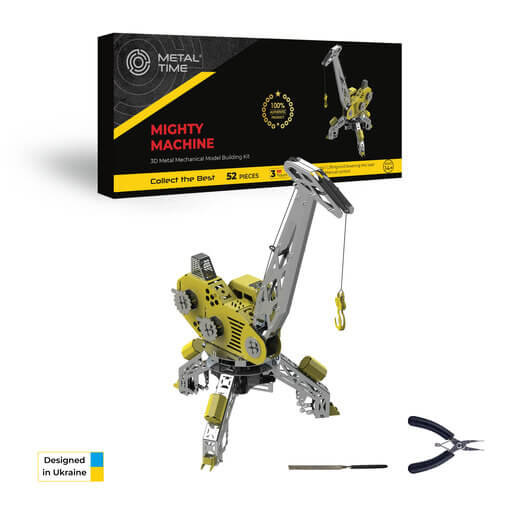
This design allows you to solve several main tasks of the crane: to increase the mass of the raised cargo, the height to which it needs to be lifted, and the force attached to this process. Modern cranes have no limit in all these parameters. Therefore, this symbol of construction is an interesting model for technical creativity.The designers of “Metal Time” analyzed many types of lifting machines and as the basis for their new self-assembling model chose a prototype of the port crane. The model demonstrates a large-scale mechanism for working with big loads. Therefore, it was called “Mighty Machine”.